
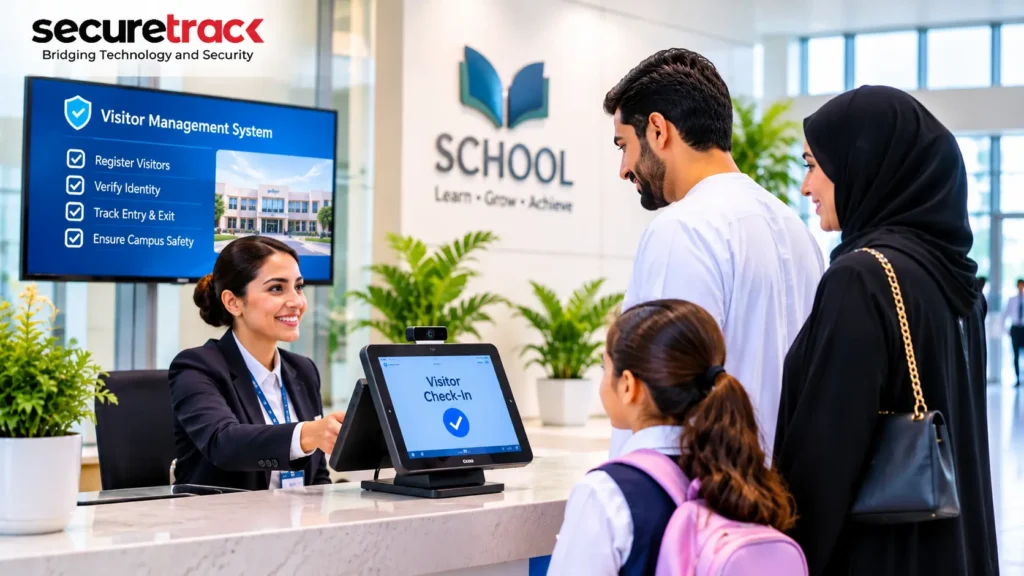
A school visitor management system digitally verifies and tracks everyone entering a school campus. Dubai schools use it to scan Emirates ID, issue visitor passes, log entry and exit times, verify student pickups and keep a live headcount for emergencies.
On a typical school morning in Dubai, the main gate sees parents dropping off children, delivery drivers, maintenance contractors, prospective families on admissions tours, visiting coaches and the occasional unexpected walk in. By afternoon the same gate handles early pickups, after school activity staff and a dismissal rush that can involve hundreds of cars in under an hour.
Every one of those movements is a safeguarding question. Who is this person? Why are they here? Who approved them? Where are they now? Have they left? And when a child leaves campus, was the adult collecting them actually authorised to do so?
A paper visitor book cannot answer those questions reliably. A school visitor management system can. This guide explains what these systems do, how they support safeguarding expectations in Dubai, how visitor management connects to student accountability, and what school operations teams should look for before they buy.
Why Is a Visitor Book No Longer Enough for Schools?
Handwritten logs have three structural weaknesses on a school campus.
First, they rely on the visitor to write truthfully and legibly. There is no check that the name matches an ID, and no record of whether the ID was even looked at.
Second, they are almost impossible to search under pressure. If a safeguarding lead needs to know whether a particular contractor was on site last Tuesday, someone has to flip through pages by hand.
Third, they say nothing about who is on campus right now. During a fire alarm or lockdown, a paper book at the gate does not tell the evacuation marshal which visitors are still inside, and the book itself may be left behind.
For a school with 1,000 or more pupils, plus staff, parents and contractors, these gaps become real risks. Digital systems close them by verifying identity at the point of entry, timestamping every movement, and keeping a live view of who is on site.
How Does a School Visitor Management System Work?
A school visitor management system digitises the full visitor journey, from the moment a visit is planned to the moment the person leaves. A typical flow looks like this.
Advance registration. Expected visitors, such as contractors, guest speakers or admissions appointments, are registered beforehand. They receive a digital invitation, often with a QR code, so check in at the gate takes seconds.
Identity verification at the gate. On arrival, the visitor’s Emirates ID is scanned by security staff or at a self service digital kiosk, or their identity is confirmed through UAE Pass. The system captures the details automatically instead of relying on handwriting.
Purpose and host confirmation. The visitor’s reason for coming and the staff member they are meeting are recorded. The host gets a notification by app, SMS, email or WhatsApp, so no one waits unattended at reception.
Visitor pass issue. A printed or digital pass is issued, usually with a photo, name, date and the areas the visitor may enter. Passes can expire automatically at the end of the visit window.
Screening against watchlists. Schools can maintain internal lists of people who should not be admitted, such as individuals subject to a court order or a parent with restricted custody rights, and the system flags them before a pass is issued.
Sign out. On departure, the pass is returned or scanned and the exit time is logged. Anyone who has not signed out by the end of the day shows up on a report.
The result is a complete, searchable audit trail, plus a real time list of every visitor currently on campus.
What Do Dubai Schools Need to Know About Visitor Safeguarding?
How KHDA Looks at Safeguarding and Site Security
Private schools in Dubai are overseen by the Knowledge and Human Development Authority (KHDA). Rather than prescribing exact visitor log fields or a particular system, KHDA’s inspection process looks at whether a school’s safeguarding arrangements, including site security, are effective in practice.
That puts the responsibility on each school to show its procedures actually work. Saying that visitors sign in is not the same as proving who was on site on a given day, how they were verified and when they left. A visitor management system turns the school’s policy into records that can be produced on request.
What a Typical Dubai School Visitor Policy Covers
Because KHDA does not set a single template, each Dubai school writes its own visitor and safeguarding policy. Most cover similar ground:
- All visitors enter through a designated gate or reception and sign in
- Identity is checked, usually against an Emirates ID
- A visible visitor badge is worn for the whole visit
- Visitors are escorted or supervised at the school’s discretion
- Classrooms and student areas are restricted unless the visitor is invited
- Visitors return the badge and sign out on leaving
A digital system makes every one of these steps consistent across shifts, gates and security staff. Emirates ID scanning confirms identity, timestamped sign in and sign out creates the log, host assignment handles supervision, and pass permissions can restrict which zones a visitor may enter. When inspectors ask how the school knows who is on site, the school can show reports rather than describe a process.
Visitor Data and Privacy
A visitor management system collects personal data: names, ID details, photos, phone numbers and visit history. For students, it may also hold pickup authorisations and family contact information. That data falls under the UAE’s federal Personal Data Protection Law, alongside any record keeping expectations set by the school’s regulator.
Schools should ask any provider where visitor data is stored, who can access it, how long it is retained, and how it is deleted. Collecting only what the school genuinely needs is the simplest way to reduce risk.
How Does a Student Tracking System Improve Student Safety?
Campus safety is not only about who comes in. It is equally about who goes out, and with whom. This is where visitor management and a student tracking system work together.
Authorised Pickup Verification
Most Dubai schools ask parents to name, in advance, the adults allowed to collect their child, such as a relative, driver or nanny. When plans change at short notice, the school needs a reliable way to record the new person, tell the gate and confirm that person’s identity on arrival.
Done on paper, this means phone calls, sticky notes and a guard trying to match a face to a name on a list. Done digitally, the authorised pickup list sits in the same system the guard uses at the gate. The collecting adult’s ID is scanned, matched against the student’s authorised list, and the release is logged with a timestamp. If the person is not on the list, the system flags it before the child is handed over.
The result is a clear, auditable pickup process that supports KHDA’s focus on effective safeguarding.
Tracking Late Arrivals and Early Departures
Students who arrive after the gates close or leave early for appointments are a common gap in accountability. A student tracking system linked to the gate can record exactly when each student entered or left, who signed them out, and the reason. That record can feed straight into attendance so the class teacher and the office see the same information.
Student Entry and Exit Logging
Many Dubai schools now issue students with ID cards that work with access control readers, speed gates and turnstiles at entrances. Each tap creates an entry or exit record, giving the school a live picture of which students are on campus. Some schools connect this to time and attendance systems to automate morning registration, or to parent notifications so families know their child has arrived.
Emergency Headcounts and Mustering
The real test of accountability comes during an evacuation or lockdown. When visitor records and student entry data live in one system, the emergency coordinator can pull up a live muster list showing every visitor, contractor and student logged as on site, then mark people safe as they reach assembly points. Anyone unaccounted for is visible immediately.
Key Features of a School Visitor Management System
Not every visitor management product is built for schools. Corporate systems are designed for a reception desk with a steady trickle of guests. Schools face sharp peaks at drop off and dismissal, a mix of adults and minors, and strict safeguarding obligations. The features that matter most include:
- Emirates ID and UAE Pass verification so identity is confirmed, not just recorded
- Advance registration with QR codes to keep peak periods moving
- Host notifications by app, SMS, email or WhatsApp so visitors are collected promptly
- Photo passes with zone restrictions and automatic expiry
- Internal watchlists and custody alerts to stop restricted individuals at the gate
- Authorised pickup management tied to each student’s record
- Live occupancy and emergency mustering for evacuations and lockdowns
- Searchable reports and exportable audit trails for inspections and investigations
- Bilingual interface in Arabic and English for gate staff and visitors
- Integration with access control, CCTV and vehicle systems so the visitor platform is part of the wider security setup rather than an isolated tool
- Clear data retention and access controls to support privacy obligations
Integrating Visitor Management with CCTV and Access Control
A visitor management system becomes far more useful when it talks to the rest of the school’s security infrastructure.
Access control. A visitor’s pass can be programmed to open only the doors they need, such as the admin block or a specific meeting room, and only during their visit window.
CCTV. Linking visitor records to CCTV footage lets the security team review exactly where a visitor went if a concern is raised later.
ANPR and gate barriers. For schools with controlled parking, automatic number plate recognition can register expected vehicles in advance and log every vehicle entering during school hours, which also helps manage the dismissal queue. Gate barriers and parking management systems complete the vehicle side of the picture.
Intercoms. At secondary entrances, an audio video intercom lets reception verify and admit a visitor remotely while still capturing the visit in the log.
Guard patrols. A guard patrolling system confirms that security staff are checking perimeters, side gates and quiet areas of the campus on schedule, adding a human layer to the digital record.
The aim is one consistent record of everyone who enters and leaves the campus, whether on foot, by car or through a side gate.
Choosing a Visitor Management System Dubai Schools Can Grow With
Schools comparing providers should look past the feature list and ask practical questions:
- Can it handle peak load? Ask how many check ins per minute the system supports and how it performs during morning drop off at a campus of 1,000 or more students.
- What happens if the network drops? The gate cannot stop working because of an internet outage. Ask about offline mode and how records sync afterwards.
- Can it be configured to the school’s own policy? Since KHDA does not prescribe a single template, the system should adapt to the school’s escort rules, restricted zones and pickup procedures rather than force a generic workflow.
- Will it integrate with existing systems? Check compatibility with the school’s current access control, CCTV and management information system.
- Where is data stored, and who owns it? Get clear answers on hosting, retention and deletion.
- Who supports it after installation? Gate staff turnover is high. Training, local support and maintenance matter as much as the software.
Timing matters too. Most Dubai schools set budgets for the next academic year in the first months of the calendar year and schedule installation work for the summer break. Planning early means the system can be live and staff trained before the new intake arrives in late August.
How to Roll Out a Visitor Management System in a School
A smooth rollout usually follows a few steps.
- Map every entry point and the type of traffic each one carries: parents, staff, students, deliveries and vehicles.
- Write the visitor and pickup policy first, then configure the system to match it, not the other way round.
- Load authorised pickup lists from parents before launch, with a simple process for updates during the year.
- Train gate and reception staff on routine check in and on exceptions, such as a visitor with no ID or a pickup person not on the list.
- Communicate with parents about what is changing at the gate and why.
- Run an evacuation drill using the new muster function, and refine the process based on what the drill reveals.
Frequently Asked Questions
Is a visitor management system mandatory for schools in Dubai?
KHDA does not prescribe a particular visitor management system. Its inspections look at whether a school’s safeguarding arrangements, including site security, are effective. A digital system is one of the clearest ways for a school to show that its visitor procedures work in practice.
What is the difference between visitor management and a student tracking system?
Visitor management controls and records adults entering the campus. A student tracking system records when students arrive, leave and who collects them. Many schools link the two so pickups, attendance and emergency headcounts all draw on the same data.
Can a school visitor management system verify Emirates ID?
Yes. Modern systems scan the Emirates ID at the gate or verify identity through UAE Pass, capturing visitor details automatically and accurately.
How does a visitor management system help during an emergency?
It provides a live list of every visitor, contractor and student logged as on site. During an evacuation, staff use this list to account for everyone at assembly points and identify anyone missing.
Can the system work with existing CCTV and access control?
Most enterprise systems integrate with access control, CCTV and ANPR. Compatibility depends on the existing hardware, so a site survey is the best first step.
Conclusion
A school visitor management system turns campus safety from a set of good intentions into a process that can be verified. It confirms who every visitor is, keeps a live record of who is on site, ensures children leave only with authorised adults, and gives safeguarding leads the evidence they need. For Dubai schools, where KHDA looks at whether safeguarding arrangements work in practice, that evidence matters as much as the policy itself.
Secure Track designs and installs visitor management systems for organisations across Dubai, with Emirates ID and UAE Pass verification, QR based check in, emergency mustering, and integration with access control, CCTV and ANPR. Schools planning upgrades for the coming academic year can contact Secure Track to discuss a solution suited to their campus layout, student numbers and safeguarding policy.