
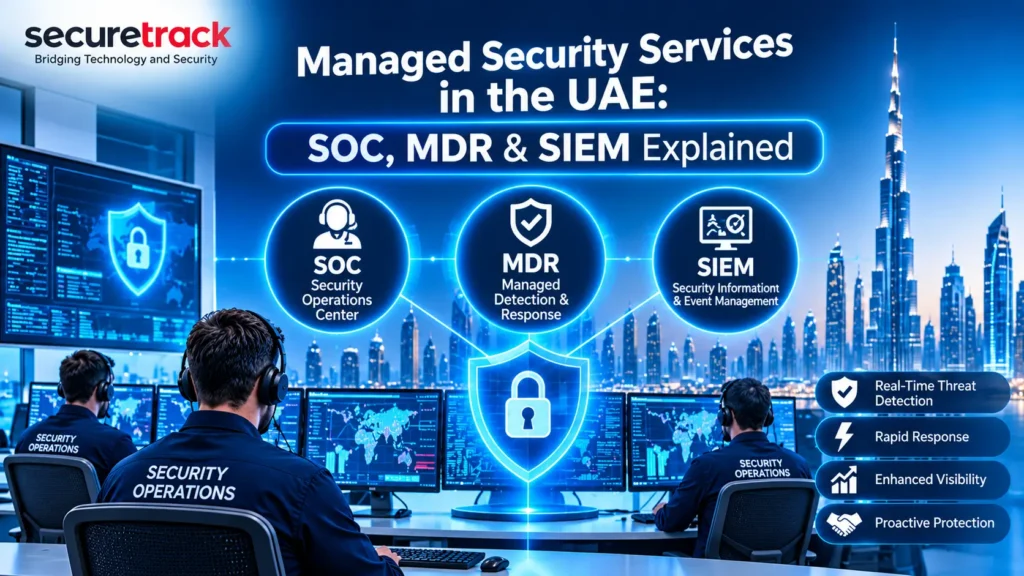
Managed security services in the UAE let businesses hand cybersecurity to a specialist provider that monitors, detects and responds to threats around the clock. A SOC is the team watching your systems, a SIEM is the platform that collects and correlates security logs, and MDR is the service that actively investigates and contains threats. SOC as a Service combines all three for a predictable monthly fee, without building an in house team.
Cyber threats in the UAE are no longer occasional events. They happen every hour, against every sector, and they are getting faster and smarter. For most businesses, building a full security team that watches systems day and night is simply not realistic. That is why managed security services in the UAE have become one of the fastest growing areas of IT investment.
This guide explains what managed security services are, how SOC, MDR and SIEM fit together, what the latest technology looks like, and how to choose the right setup for your organisation.
Why UAE Businesses Are Turning to Managed Security
The numbers from the UAE’s own authorities show the scale of the problem. In October 2026, the UAE Cybersecurity Council reported thwarting nearly 750,000 cyberattack attempts in recent months, with energy and education among the most targeted sectors. The attempts included remote code execution, DDoS attacks, phishing and AI powered attacks.
Earlier in the year, the Council said around 800,000 cyberattacks are recorded daily across the country, with threats becoming more complex and increasingly driven by artificial intelligence. It also reported that 71.4 percent of tracked threats came from state backed advanced persistent threat groups, and 128 confirmed incidents, including ransomware and data breaches, had been recorded across government and private entities since the start of 2026.
At that level of activity, a firewall and antivirus are not enough. Organisations need people and systems watching around the clock, and that is exactly what managed security providers deliver. Market data reflects this shift: the UAE managed detection and response market was valued at about USD 113.4 million in 2026 and is projected to reach USD 425.4 million by 2031, growing at roughly 30% a year.
What Are Managed Security Services?
Managed security services means handing the day to day work of protecting your IT environment to a specialist provider. Instead of hiring, training and retaining an internal security team, you pay for a service that monitors, detects, investigates and responds to threats on your behalf.
A typical managed security package can include:
- 24/7 monitoring of networks, servers, endpoints and cloud systems
- Log collection and analysis through a SIEM platform
- Threat detection, investigation and response
- Vulnerability scanning and patch guidance
- Compliance reporting for UAE regulations
- Incident response support when something goes wrong
The three terms you will hear most often are SOC, SIEM and MDR. They are related, but they are not the same thing.
SOC Explained: The Security Command Centre
A Security Operations Centre (SOC) is the team and the facility responsible for watching your environment continuously. SOC analysts review alerts, investigate suspicious activity, hunt for hidden threats and coordinate the response when an incident happens.
There are two main ways to get a SOC:
In house SOC: You build it yourself. This gives you full control, but it means hiring skilled analysts for three shifts, buying expensive tools and keeping everyone trained. For most small and medium businesses, the cost is hard to justify.
SOC as a Service: A provider runs the SOC for you and monitors your systems remotely. You get round the clock coverage, experienced analysts and enterprise grade tools for a predictable monthly fee. SOC as a Service is the most common choice for UAE businesses that need serious protection without the overhead of a full internal team.
Some organisations choose a hybrid model, where their internal IT team handles daily operations and the provider covers nights, weekends and advanced investigations.
SIEM Explained: The Brain That Connects the Dots
A SIEM (Security Information and Event Management) platform is the technology that collects logs and events from across your environment, including firewalls, servers, email, cloud apps and user accounts, and puts them in one place.
The SIEM then correlates this data to spot patterns that would be invisible if you looked at each system separately. For example, a failed login in Dubai followed by a successful login from another country two minutes later is a red flag a SIEM can catch.
A SIEM on its own is a tool, not a service. It generates alerts, but someone still has to review them, decide what is real and take action. That is where the SOC comes in. In most managed security setups, the SIEM is the engine and the SOC team is the driver.
MDR Explained: Detection Plus Action
Managed Detection and Response (MDR) goes one step further than traditional monitoring. An MDR provider does not just tell you something looks wrong. It actively investigates the threat and takes action to contain it, such as isolating an infected laptop, blocking a malicious IP address or disabling a compromised account.
MDR usually relies on endpoint detection and response (EDR) or extended detection and response (XDR) tools, combined with human threat hunters who look for attackers that automated tools might miss.
The key difference is speed. With basic monitoring, you get an alert and your team must respond. With MDR, the response often happens within minutes, before ransomware can spread or data can leave the network.
SOC vs SIEM vs MDR: Quick Comparison
| SIEM | SOC | MDR | |
| What it is | A technology platform | A team and process | A complete managed service |
| Main job | Collect and correlate logs | Monitor, investigate, coordinate response | Detect, investigate and actively contain threats |
| Who acts on alerts | Nobody, unless you staff it | SOC analysts | Provider’s analysts, often with automated response |
| Best for | Visibility and compliance logging | Continuous oversight | Fast, hands on threat response |
In practice, the best managed security services in the UAE combine all three: a SIEM for visibility, a SOC for oversight and MDR for rapid action.
The Latest Technology: Agentic AI Is Changing the SOC
The biggest shift in 2026 is the move from AI assistants to AI agents that can investigate and respond on their own, within limits set by human analysts.
At RSA Conference 2026, CrowdStrike, Cisco/Splunk and Palo Alto all released production agentic SOC tools at the same time, with Cisco announcing six specialised AI agents for Splunk Enterprise Security.
The results from real operations are significant. After a full year running an agentic SOC, Sophos reported 89 seconds from case creation to fully automated response, with 52% of MDR cases closed end to end by AI, across 40,000 customers. Importantly, human analysts still make the high stakes decisions where business impact or unusual attacker behaviour requires judgment, while AI handles the high volume work that used to consume Tier 1 analyst time.
Other technology trends worth knowing:
- XDR: Brings endpoint, network, email, identity and cloud signals into one detection platform instead of separate tools.
- Next generation SIEM: Cloud native platforms that scale easily and use AI to reduce alert noise.
- UAE data residency: Many providers now keep security logs, alerts and forensic data within UAE borders to address data sovereignty requirements.
Case Studies: Managed Security in Action in the UAE
DAMAC: The Dubai based developer chose Rapid7’s cloud delivered MDR service to gain real time endpoint visibility and 24/7 SOC coverage, freeing its own team to focus on governance and strategic security work.
Al Ghurair: As its endpoint count and digital footprint grew, Al Ghurair needed centralised security with full visibility across cloud and on premises systems. Working with Trend Micro, it sped up detection and response by up to 70%.
Danube Group: The UAE property and home design brand selected Secureworks’ Taegis ManagedXDR Plus as its MDR solution to strengthen its protection against growing threats.
The common thread is clear. Large UAE organisations with their own IT teams still choose managed services, because round the clock expert coverage is difficult to build and keep internally.
Managed Security and UAE Compliance
UAE businesses operate under several cybersecurity frameworks, depending on their sector and emirate. A managed security provider can help meet monitoring, logging and incident reporting expectations across them:
- UAE Information Assurance (IA) Standards: Apply to government entities and critical infrastructure. The framework traces back to NESA and now sits with the TDRA and the UAE Cybersecurity Council.
- Dubai DESC ISR: Applies to Dubai Government and many semi government and regulated entities in the emirate. DESC also publishes a dedicated Security Operations Center standard alongside the ISR.
- ADHICS: Issued by the Department of Health Abu Dhabi for the emirate’s health sector.
- CBUAE requirements: Banks, insurers and payment firms answer to the Central Bank.
- UAE PDPL: The federal personal data protection law, relevant to any business handling customer data.
A good provider will produce audit ready reports mapped to the frameworks that apply to you, which saves your team significant time during assessments.
How to Choose a Managed Security Provider in the UAE
Before signing a contract, ask these questions:
- Is monitoring truly 24/7? Confirm analysts are active around the clock, not just automated alerts after hours.
- What response actions are included? Some services only notify you. MDR should include containment.
- Where is your data stored? Check whether logs and alerts stay inside the UAE.
- Which compliance frameworks do they support? Make sure they understand IA, DESC ISR, ADHICS or CBUAE, depending on your sector.
- How do they use AI? Ask how much is automated and where human analysts stay in control.
- What are the response time commitments? Look for clear service levels for detection and containment.
- Does it integrate with your current setup? A good provider should work with your existing firewalls, endpoints and cloud platforms.
How Secure Track Can Help
Secure Track provides SOC and SOC as a Service solutions across the UAE, combining continuous security monitoring, threat detection and incident response, so your business is protected around the clock without the cost of an in house team. Alongside SOC as a Service, our team delivers Managed Detection and Response, SIEM, EDR and XDR solutions, and managed firewall services for businesses in Dubai and Abu Dhabi. Talk to our experts to find the right managed security setup for your organisation.
Frequently Asked Questions
What is the difference between SOC and MDR?
A SOC is the team that monitors and investigates security alerts. MDR is a complete service that includes monitoring, investigation and active response to contain threats. Many MDR services are delivered from a SOC.
Is SOC as a Service suitable for small businesses?
Yes. SOC as a Service gives small and medium businesses access to round the clock monitoring and skilled analysts at a fraction of the cost of building an internal team.
Do I still need a SIEM if I use MDR?
It depends. Many MDR providers include a SIEM or XDR platform as part of the service. If you have compliance requirements for log retention, confirm the provider covers them.
Can managed security services help with UAE compliance?
Yes. Providers can supply continuous monitoring, log retention and audit reports aligned with frameworks such as the UAE IA Standards, DESC ISR, ADHICS and CBUAE requirements.
How fast can MDR respond to a threat?
Response times vary by provider. With AI assisted operations, leading services now contain many common threats within minutes.