
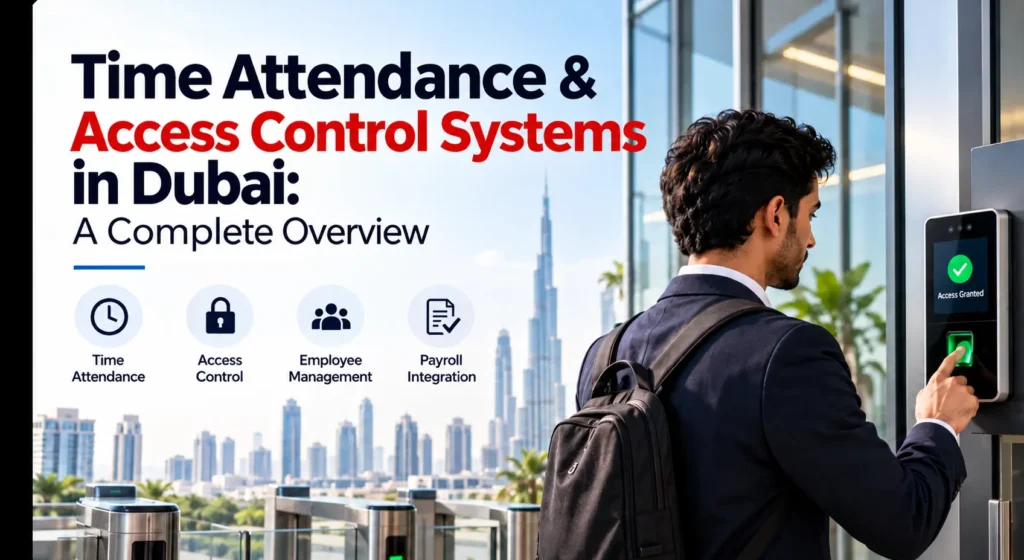
What Is a Time Attendance System?
A time and attendance system in Dubai is technology that records when employees start and end work, replacing manual sign in sheets or spreadsheets with automated tracking. Most modern systems use a physical credential, a fingerprint, a face scan, or a card, to verify identity at the moment of clock in, and many of these systems also double as the building’s access control, governing which doors or zones an employee can enter. The two functions, tracking hours and controlling entry, have increasingly merged into a single piece of hardware rather than remaining two separate purchases.
Who Actually Needs This
Any business with more than a handful of employees, multiple shifts, or a physical office reaches a point where manual attendance tracking stops being manageable. Facilities managers evaluating a new office fit out, HR teams tired of chasing manual timesheets, and business owners opening a second location are the three groups who typically end up researching this. The right system looks different for each, a small single office team has very different needs from a business running shifts across a warehouse and a corporate office simultaneously.
Time Attendance and Access Control Are Often the Same System
In practice, they run on the same hardware. The reader that logs someone in for payroll purposes is frequently the exact device that decides whether that person can open a specific door. Businesses that treat these as two separate purchases, buying an attendance system from one vendor and access control from another, often end up with duplicate hardware and two systems that don’t talk to each other. Planning them together avoids that, and usually costs less overall than solving each problem separately as it comes up.
Credential Options for a Time and Attendance System in Dubai
A biometric time attendance system in Dubai usually relies on fingerprint or facial recognition, but there are several established methods, each suited to different situations:
-
- Fingerprint recognition — the most widely deployed method, fast and inexpensive, best for stable office teams with low staff turnover. Less reliable for workers whose fingerprints wear down from manual labor, a real limitation in construction, warehousing, and similar physically demanding roles.
-
- Facial recognition — contactless and doesn’t degrade with physical wear, increasingly the preferred choice across labor intensive and mixed workforces. Performance depends more on lighting and camera placement than fingerprint systems typically do.
-
- Card or RFID badges — simple proximity cards, cheaper to deploy, don’t involve collecting biometric data at all. Remains a reasonable option for businesses not ready to take on biometric data handling.
-
- PIN codes — used alone or layered with another credential for higher security areas, adding a second verification step without additional hardware cost.
-
- Mobile credentials — smartphone based access via app or Bluetooth, growing in newer building deployments where employees already carry a company device.
-
- QR code check in — typically used for visitors or temporary staff rather than daily employee attendance, since it’s fast to issue and doesn’t require enrollment.
-
- Iris, retina, voice, or hand geometry — reserved for high security or specialized facilities, government sites, data centers, rarely justified for a standard office given the added cost.
Most UAE businesses end up combining methods rather than standardizing on one, biometric for daily staff attendance, and a different credential mix for visitor or contractor access where enrollment isn’t practical.
What Access Control Covers Beyond the Door
A complete access control setup typically includes zoning, different credentials cleared for different areas, so not everyone with a valid attendance credential can access every part of the building. It also includes multi factor verification for sensitive zones, where a card alone isn’t considered sufficient and a PIN or biometric check is added. In multi tenant towers, access control frequently extends to elevators, restricting which floors a lift will even stop at for a given credential. It also needs to integrate with fire and life safety systems, doors have to unlock automatically during a fire alarm trigger, a genuine safety requirement rather than a security feature. Finally, every credential use generates an audit trail, a record of who accessed what and when, which becomes essential during a compliance review or an incident investigation.
Cloud vs On-Premise Deployment
Cloud based systems are managed from a central dashboard and scale easily across multiple offices or locations, which suits growing businesses that expect to add sites over time. On-premise systems keep infrastructure and data fully within the business’s own control, often preferred where there’s a specific regulatory or data residency requirement, or where a business simply wants everything hosted on its own servers rather than a third party’s. Neither is universally better, the right choice depends on how many locations are involved, how quickly the business expects to grow, and how the business wants to handle its own data long term.
Integrating With Payroll and HR Software
This matters more than most buyers initially realize. An attendance system that doesn’t connect to payroll requires manual re-entry of hours, which reintroduces the exact human error the system was meant to eliminate in the first place. A properly integrated time and attendance system in Dubai automatically handles shift schedules, overtime calculations, and leave tracking, feeding directly into payroll without a manual step in between. This is also where many otherwise good systems fall short in practice, the biometric or card hardware works fine, but the software behind it doesn’t talk cleanly to whatever payroll platform the business already runs, creating exactly the kind of administrative bottleneck the system was supposed to remove.
Installation and Ongoing Maintenance
Installation typically includes mounting the reader hardware, wiring it into the building’s network and power, and configuring the software to match the business’s shift patterns, access levels, and payroll rules. This isn’t usually a same day job for anything beyond a single small office, multi zone or multi floor deployments take longer to configure correctly. Ongoing maintenance matters too, biometric sensors need occasional cleaning and recalibration, software needs updates, and as staff join or leave, credentials need to be enrolled or revoked promptly, a task that’s easy to overlook and becomes a real security gap if ignored.
The UAE Compliance Layer for Biometric Data
This is where a lot of content aimed at this exact market gets it wrong. Under the UAE’s Personal Data Protection Law, Federal Decree-Law No. 45 of 2021, biometric data, fingerprints, facial scans, iris data, is classified as sensitive personal data, placed in the same category as health and genetic information. Any business installing a biometric time attendance system in Dubai needs explicit, informed consent from employees, not a general clause buried in an employment contract. Larger scale biometric deployments can also trigger a mandatory Data Protection Impact Assessment. This is UAE specific law, distinct from GDPR, which is European legislation with no legal authority here, a distinction some vendor content aimed at this market gets wrong by citing GDPR instead. Card, PIN, and mobile credential methods don’t collect biometric data, so they don’t carry this same compliance requirement.
How to Decide What to Install
Choosing the right time and attendance system in Dubai comes down to five practical questions:
-
- What’s the makeup of the workforce, office based, labor intensive, or mixed, since this affects which credential holds up best day to day.
-
- Does the building need different access levels for different zones, and does the system support that level of granularity.
-
- Is the business ready to handle PDPL consent requirements for biometric data, or is a non-biometric option a better fit for now.
-
- Will this need to scale across multiple locations, and does the platform support centralized management.
-
- Does it need to integrate with existing payroll, HR, or building management systems already running.
Businesses already evaluating access control as part of a broader security setup should scope time attendance in the same conversation. Since the two often run on the same hardware and infrastructure, planning them separately usually means paying for the same groundwork twice, and results in two systems that were never designed to work together in the first place.
Frequently Asked Questions
Do attendance and access control have to be separate systems?
No. In most modern deployments, the same credential and often the same hardware serves both attendance tracking and door or zone access.
Is biometric data treated differently under UAE law?
Yes. The UAE’s Personal Data Protection Law classifies biometric data as sensitive personal data, requiring explicit consent and, for larger deployments, a formal Data Protection Impact Assessment.
What’s the difference between cloud and on-premise systems?
Cloud systems are centrally managed and scale easily across locations. On-premise systems keep data and infrastructure fully within the business’s own control, often chosen for specific regulatory reasons.
Can access control extend beyond doors?
Yes. It commonly extends to elevators and floor access in multi tenant buildings, and integrates with fire alarm systems so doors unlock automatically in an emergency.
Is fingerprint or facial recognition better for a typical office?
Both work well for stable office teams. Facial recognition has an edge for hygiene and doesn’t degrade with physical wear the way fingerprints can.
How long does a typical installation take?
A single office with a straightforward layout can usually be completed in a matter of days. Multi zone, multi floor, or multi site deployments take longer, since each zone needs its own configuration and testing.
Conclusion
A time and attendance system in Dubai is rarely a standalone purchase anymore, it’s usually one part of a combined attendance and access control setup running on shared hardware. The right choice depends on the workforce, how the building needs to be zoned, readiness for biometric data rules under UAE law, and how cleanly the system connects to existing payroll and HR tools. Secure Track designs, installs, and maintains time attendance and access control systems for businesses across Dubai. Whether you need a biometric time attendance system in Dubai for a single office or a combined attendance and access setup across multiple sites, the Secure Track team helps you plan both together, handles installation and configuration, and supports the system long after it goes live, so it works the way your business needs it to. Get in touch with Secure Track at https://www.securetrack.ae/ to discuss the right setup for your workplace.