
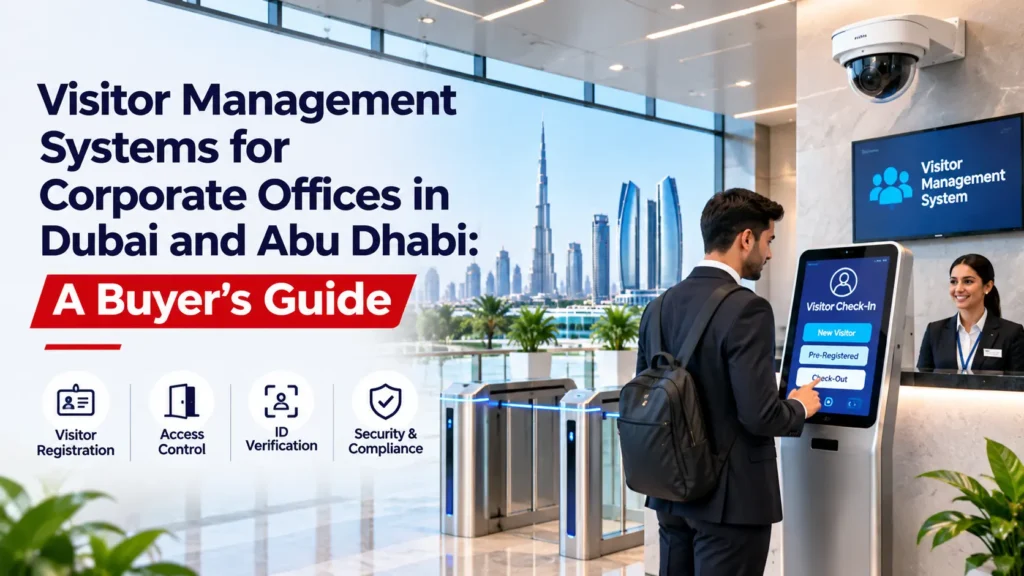
This buyer’s guide covers what a visitor management system actually does, and what UAE offices specifically need that most global guides miss, Emirates ID and UAE Pass verification, working alongside a building’s existing access control, and what actually changes between a Dubai tower and an Abu Dhabi one.
A typical corporate office in Dubai or Abu Dhabi processes more non employee traffic in a week than most people realize, contractors, couriers, job candidates, auditors, client meetings, delivery staff, and the occasional building inspector. Most offices still track this the old way, a logbook at reception, or in some cases nothing more structured than a phone call down to security asking them to send someone up. That works, until a fire drill leaves nobody able to say who’s actually in the building, or an audit asks for visitor logs that only exist as an illegible stack of paper nobody has scanned.
A visitor management system replaces manual sign in with software that verifies identity, controls where a visitor is allowed to go once inside, and keeps a record that holds up when someone actually needs it, whether that’s a landlord, an auditor, or a security team reconstructing a timeline after an incident. Here’s what one does, what makes the UAE market meaningfully different from anywhere else, and what to check before buying one, whether the office in question is in Dubai or Abu Dhabi.
What Is a Visitor Management System?
A visitor management system registers, verifies, and tracks anyone entering a facility who isn’t an employee. It replaces the front desk logbook with digital check in, temporary access credentials, host notifications, and a searchable record of who was on site and when.
The better systems don’t operate as a standalone app sitting next to reception, they sit inside the building’s broader access control setup, so a visitor’s credential actually does something once they’re past the front desk, opening the right lift or floor and nothing else. A system that only handles sign in and stops there is solving half the problem, controlling where a visitor can actually go once inside is where the real security value sits.
How Does a Visitor Management System Work?
Pre registration lets a host invite a visitor ahead of time and collect their details in advance, which speeds up the arrival experience and gives security a heads up on who to expect. Check in happens at a kiosk, tablet, or QR code on arrival, with ID verification built directly into that step rather than handled separately afterward.
Once checked in, the system issues a temporary credential scoped to specific floors or zones, notifies the host the moment the visitor arrives, and gives reception or security a live view of who’s currently on site. That live view matters most during an emergency, when knowing exactly who’s in the building and where can shape how an evacuation is managed. When the visitor leaves, the system logs the check out automatically and closes the record, so nothing depends on someone remembering to note the time on the way out.
Key Components of a Visitor Management System
- Digital check in through kiosk, tablet, QR, or mobile
- ID capture and verification, including Emirates ID or UAE Pass where required
- Integration with the building’s existing access control
- Automatic host and reception alerts
- Watchlist screening
- Reporting and audit trail
- Emergency roll call support
For a closer look at how the access control side of this actually works, see this complete guide to access control systems.
Types of Visitor Management Systems
Basic kiosk software digitizes sign in but doesn’t connect to access control, workable for a small office with light visitor traffic and no landlord system to coordinate with, essentially a digital upgrade to the paper logbook without the deeper integration layer. Cloud based platforms scale across multiple offices and suit a company planning to open more locations, say a Dubai head office adding an Abu Dhabi branch, since a new site can generally be added to the same dashboard rather than standing up a separate system from scratch each time. Fully integrated systems connect directly to existing access control, HR, and building security, which is what most mid sized to large UAE offices actually need, since very few buildings start with a blank slate. Platforms such as Entry2Exit, for example, are built around this kind of open integration framework, connecting visitor management with access control and ANPR across different hardware brands rather than operating as a closed, standalone product. On premise systems are less common now but still requested by tenants in regulated sectors, financial services, government adjacent entities, healthcare, who prefer to keep visitor data on infrastructure they directly control rather than a third party cloud environment.
Why Corporate Offices Need Visitor Management
This need looks different in the UAE than most buyer’s guides assume, since most are written for a US or UK audience where none of these specifics apply. Identity verification expectations here are different from the start, Emirates ID scanning and UAE Pass authentication are becoming the standard way to verify a visitor’s identity, not an optional add on bolted onto a system built for a different market.
Most corporate offices, particularly in areas like DIFC, Business Bay, or JLT in Dubai, and increasingly on Abu Dhabi’s Corniche or in Masdar City, sit inside multi tenant towers rather than standalone buildings. That means visitor management has to coexist with whatever base building access system the landlord already runs, not replace it, and that coordination, not paperwork, is usually what makes or breaks a rollout. A paper log addresses none of this, and stops being a real control the moment something goes wrong.
Benefits of Visitor Management Systems
- Security improves because unauthorized visitors are flagged before reaching a lift lobby or a restricted floor, rather than being noticed after the fact.
- Compliance gets easier, since the business has a defensible, searchable record rather than a handwritten book nobody can search or produce on demand.
- Reception stops being a bottleneck, since hosts are notified automatically instead of walking down to collect guests themselves.
- Emergency response gets faster and more accurate, since an instant roll call is available during a drill or a real evacuation.
- First impressions improve too, since a visitor who checks in in seconds notices that, even if they don’t say it out loud.
How to Choose the Right System
- Check whether the system supports Emirates ID or UAE Pass verification natively, rather than as a workaround layered on top of a system built for a different market.
- Ask how the system will coexist with the building’s existing base building access control, especially in a multi tenant tower, and ask for concrete examples of buildings it has integrated with before, in the same emirate the office is in.
- Confirm where visitor ID data is stored and who can access it, since this becomes relevant the moment a question comes up later.
- Ask for live references from existing clients in the same emirate, since a system that performs well in a Dubai tower doesn’t guarantee a smooth integration with an Abu Dhabi landlord’s setup.
Only after these four are settled does it make sense to compare kiosk design, dashboard reporting, or branding, since those are real considerations, but they’re not the ones that determine whether the system actually works for the building it’s going into.
Why SecureTrack Is the Right Choice
SecureTrack, a Dubai based ELV and security integrator operating since 2015, builds visitor management deployments that include Emirates ID scanning and UAE Pass authentication for identity verification, across offices in both Dubai and Abu Dhabi. Rather than treating visitor management as a standalone product, SecureTrack integrates it with the CCTV, access control, and cabling already running in a building, which is the difference between a system that technically works and one that actually fits how a UAE office building operates. That integration first approach matters most in the exact scenario described earlier, a tenant inside a multi tenant tower, whether in a DIFC tower or an Abu Dhabi business district, who needs a system that works with the landlord’s existing infrastructure rather than around it.
Frequently Asked Questions
Does the system work the same way in Dubai and Abu Dhabi?
The software itself works the same everywhere. What changes is which base building access system it has to integrate with, and that depends on the specific tower and landlord, not the emirate.
Does a visitor management system work with any kind of office building?
It works best when it can plug into whatever access control the building already has, especially in a multi tenant tower, which is the normal setup for most offices in Dubai and Abu Dhabi. A standalone building gives more flexibility since there’s no landlord system to coordinate with.
Can it integrate with a landlord’s existing building access system?
In most cases yes, but integration quality varies significantly between vendors, so test this early with specific, named examples rather than assuming.
How long does implementation take?
A single office with existing access control usually takes a few weeks. Multi site or shared tower rollouts take longer, mainly due to landlord coordination rather than the technology itself.
What’s the typical cost structure?
Most vendors price on a mix of hardware, software licensing, and installation, with ongoing support often bundled into an Annual Maintenance Contract, a common structure in the UAE facilities management market.
Can it handle high visitor volumes, like a large contractor workforce?
Yes, cloud based and fully integrated systems support batch pre registration for teams arriving together.
Conclusion
A visitor management system for offices earns its place the moment reception can no longer confidently answer who’s currently in the building. That moment tends to arrive earlier than most businesses expect, usually somewhere between the first serious security incident and the first time someone asks for a visitor log that doesn’t exist in a usable form.
In the UAE specifically, whether the office sits in a Dubai tower or an Abu Dhabi one, what separates a system that actually works from one that merely works elsewhere comes down to a handful of details rather than a long feature checklist, native Emirates ID and UAE Pass support, and the ability to sit alongside a landlord’s existing access control rather than fight it. Get those right, and the rest of the buying decision becomes a far easier conversation to have.