Smart Classroom Solutions in UAE: A Complete Guide
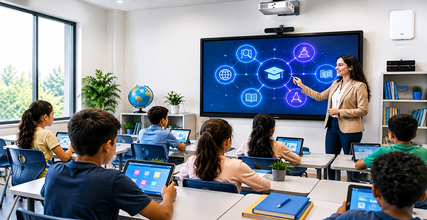
Education is becoming increasingly technology-driven, and classrooms are evolving with it. From interactive displays and digital content to wireless presentation tools and integrated audio systems, technology is changing how teachers deliver lessons and how students engage with learning. For schools, universities, training centres, and other educational institutions, adopting the right technology is no longer simply about having modern equipment. It is about creating a connected learning environment where technology supports teaching rather than becoming a distraction. Smart classroom solutions in the UAE bring together interactive displays, audio-visual systems, presentation technologies, connectivity, and classroom control tools to create more engaging and efficient learning spaces. When these systems are professionally designed and integrated, they can support different teaching methods, improve collaboration, and make digital content easier to use. This blog explores what a smart classroom is, how smart classroom technology works, the key components involved, its benefits, challenges, and how UAE institutions can choose the right solution provider. What Is a Smart Classroom? A smart classroom is a technology-enabled learning environment that integrates digital displays, interactive teaching tools, audio-visual equipment, connectivity, and classroom management technologies to support more engaging and collaborative teaching. Unlike a conventional classroom that may rely primarily on a whiteboard, projector, or printed materials, a smart classroom connects multiple technologies into a more interactive learning environment. Teachers can display multimedia content, annotate lessons, share digital resources, conduct interactive activities, and connect with remote participants when required. A typical smart classroom may include interactive displays, projectors, professional audio systems, wireless presentation solutions, cameras, document cameras, classroom control systems, and reliable network connectivity. The objective is not simply to add more technology to a classroom. The objective is to make technology easier to use while supporting the way educators teach and students learn. Why UAE Institutions Are Adopting Smart Classrooms Educational institutions across the UAE are increasingly adopting technology to support blended learning, multimedia teaching, collaboration, and digital content delivery. As classrooms become more connected, smart classroom technology provides educators with the tools to create more interactive and flexible learning environments. Another key factor is the changing nature of classroom engagement. Students are increasingly familiar with digital content, interactive platforms, and connected devices. Smart classrooms allow educators to incorporate presentations, videos, digital resources, interactive activities, and remote participation into lessons without disrupting the flow of teaching. The UAE’s diverse educational landscape also requires flexible and scalable technology solutions. Institutions can benefit from standardized AV and interactive systems across multiple classrooms, making technology easier to manage, maintain, train users on, and expand as the institution’s requirements evolve. Key Components of a Smart Classroom A smart classroom consists of multiple technologies working together. The exact configuration depends on the room, teaching requirements, student capacity, and institution’s infrastructure. How Smart Classroom Systems Work A smart classroom connects teaching, AV, and digital technologies into one coordinated environment, allowing educators to manage lessons and content more efficiently. Types of Smart Classroom Solutions Not every educational space requires the same technology. Smart classroom solutions can be designed around the size, purpose, and teaching model of each environment. Benefits of Smart Classrooms Smart classroom technology makes learning more engaging by combining interactive displays, multimedia content, digital resources, and collaborative tools. It allows educators to present complex concepts through different formats while giving students more opportunities to participate and interact with lessons. Connected classrooms also provide greater teaching flexibility and improve communication. Educators can move seamlessly between presentations, videos, online resources, interactive activities, and remote sessions, while integrated audio and video systems ensure clear communication in both physical and hybrid learning environments. Centralized controls simplify classroom management by allowing teachers to operate multiple devices through a unified interface. With a scalable technology framework, institutions can standardize smart classrooms across multiple spaces, simplify training and maintenance, and expand their technology infrastructure as their requirements grow. Challenges & Considerations for UAE Institutions Implementing a smart classroom requires more than installing interactive displays or projectors. Institutions should first assess their existing electrical, network, and structured cabling infrastructure to ensure it can support the new technology. The solution should also be easy for teachers to operate, with simple and consistent controls that fit naturally into everyday teaching. Integration is another important consideration. Displays, audio systems, cameras, presentation tools, and conferencing platforms should work together as one coordinated solution. Institutions should also consider scalability, ensuring the technology can be expanded across additional classrooms as requirements grow. Ongoing maintenance and user training are equally important for long-term performance. Teachers and administrative teams should be comfortable using the technology, while regular technical support helps minimize classroom disruptions. Budget planning should also account for installation, integration, training, maintenance, upgrades, and equipment replacement throughout the system’s lifecycle. How to Choose the Right Smart Classroom Provider in UAE Selecting the right smart classroom provider requires more than comparing products and prices. Look for a provider with experience in educational environments and an understanding of the requirements of classrooms, lecture halls, training spaces, and multi-room deployments. Choose a technology integrator that can handle the complete project, from solution design and installation to system integration, testing, configuration, and user training. The proposed solution should also be compatible with your existing network, devices, software platforms, and collaboration tools. For larger projects, scalability is essential. The provider should be able to maintain consistent technology standards across multiple classrooms while adapting each space to its specific requirements. This makes future expansion and system management more efficient. Finally, consider after-sales support and maintenance. Reliable technical support helps resolve issues quickly, minimize classroom disruptions, and ensure your smart classroom technology continues to perform effectively over the long term. Why SecureTrack Is the Right Choice SecureTrack delivers smart classroom solutions as integrated technology environments rather than standalone equipment. By combining AV, IT, ELV, networking, and system integration capabilities, we help educational institutions create connected and efficient learning spaces. Our solutions can bring together interactive displays, projectors, professional AV systems, wireless presentation, network connectivity, video conferencing, and centralized control. This integrated approach allows institutions to manage multiple